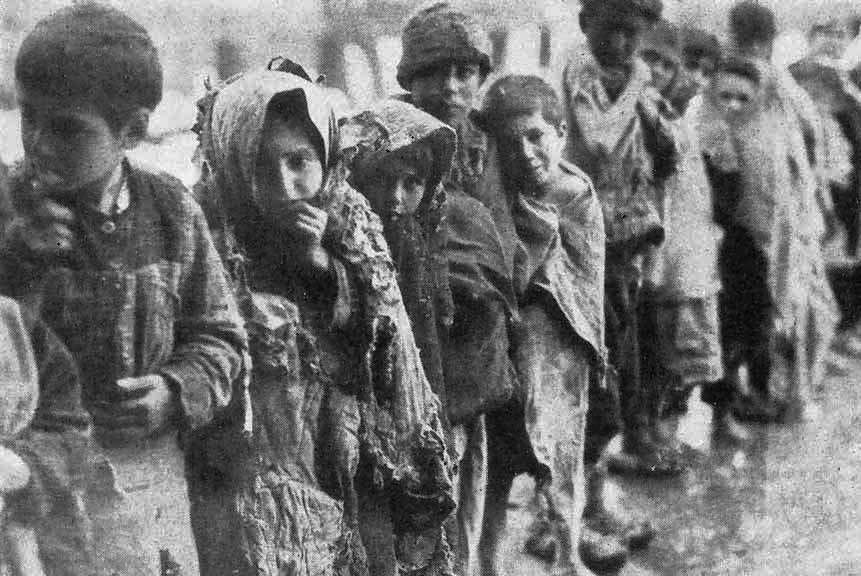
The Armenian Question

armenian children genocide
“The Armenian Question” is a phrase historically rooted to the Armenian Genocide, the cruelly horrific massacre of 1.5 million Armenians by the Ottoman Turks. Premeditated and systematic, history records the desecration of a nation – the near extinction of a people group. Often seen as a Christian persecution, the torture, rapes, mass killings and death marches punctuate immeasurable grief endured from 1915 to 1922. Adding to the inhumanity is the ongoing Turkish denial of such atrocities, a futile standpoint in light of historical fact, serving only to fester deep wounds.
Armenians often boast of being ‘the first Christian nation, 301 AD’. I myself was such a boaster who, without notice, could give a historical account of King Tiridates and Saint Gregory the Illuminator to anyone who would listen. From a Biblical perspective, claiming a nation be Christian broadens the definition of Christian to near obscurity if a Christian is one who decidedly repents, receives forgiveness, and follows and serves Christ as Lord. Nonetheless, Armenia was a nation, clothed with a claim to Christ, who was brutalized, pummeled and massacred by Islamic neighbors. History reveals the fate of Armenian borders and genocide survivors around the world. An untold causality, in this near death of a nation, is faith in the living Christ as many in surviving generations have deemed God irrelevant and/or non-existent.

With vehemence an Armenian Question took root: “Where was God?” – a question with deep accusation, not spiritual search.

Rhetorical accusation, without searching, justifies a self-made, even self-serving answer. While there exists an innate desire to know one’s Maker, there is also prideful satisfaction of dismissing God, judging Him irrelevant or non-existent, to live a life seemingly free from His authority. For some however, there is a grieving desire to know God and personally receive the truth of His sovereignty in light of gross injustice and suffering. While volumes have been written on these subjects, there are Biblical truths to ponder in beginning this search for understanding. “God is a rewarder of those who diligently seek Him” (Hebrews 11:6) and what we find in sincere and diligent search will open a relationship with the living God.

The Bible presents prophetic scriptures pointing to the Savior, Jesus Christ. The coming Christ did not change the course of a wicked and dark world. In fact, in response to the Savior’s birth the king of Judea ordered a massacre, killing all the male children under two in efforts to kill the Son of God (Matthew 2:16). God never said He would change the course of this world, He pronounced His coming judgment on our fallen world. Yet the Bible, as well as believers through the ages and today, proclaims the Spirit of God indwelling faithful men with supernatural power to endure.

"My God, my God, why have you forsaken me?"

“My God, my God, why have you forsaken me?”

“This is my beloved Son” God proclaimed at the onset of Christ’s ministry and at His transfiguration, seen in Matthew 17 and Mark 9. God allowed, even predestined, His only Son, beloved Son, to die a worse death than we could ever know. Tortured and mocked, forsaken by His people, forsaken by His Father, shamed with public execution, the Son of God took on our sins and defeated death. The punishment for every vile and violent act, hatefulness, selfishness, murder, slander – the pride of man – all laid upon the sinless Son of God as He died in our place. “Let us fix our eyes on Jesus,” the Bible encourages, “…who for the joy set before him endured the cross, scorning its shame…” (Hebrews 12:2) Your salvation, my salvation was the joy set before Him. Not so we would enjoy this world, but that we would enjoy eternity with Him, being reconciled to God.

The Armenian Genocide was a horrific display of brutal wickedness – not quickly done nor in the dark but a procession of death – while the world watched. Those with power chose not to intervene as a nation was crushed. Men at heights of leadership utilize great skill in covering guilt, cloaking complicity, and diverting responsibility. There is accountability upon all of us who do nothing when screams of terror come forth.  While cries for justice slowly die of exhaustion, God remembers every detail with accuracy.  “Vengeance is Mine”, says the Lord, “I will repay”. Even the most just of men have but a brief lifetime to exact judgment. God has eternity.

“Armenia – the first Christian nation, 301 AD” is a historical fact but an unlikely spiritual reality. No king can decree that all his subjects repent, and ‘deny themselves, pick up their cross and follow Christ’ with a readiness to give their lives for this faith. (Luke 9:23&24)  Nonetheless, many with great faith in Christ perished.   Many survivors held to Christ with a living faith, only possible through the Holy Spirit.   Following the Savior is an unpopular path on which thousands today suffer persecution, rejection and martyrdom.  Yet surrendered to Christ, His Spirit indwells us and “the joy set before Him” becomes our joy, His strength becomes our strength.  Only He can take us through a storm of suffering.   Testimonies of Christian martyrs tell of the “fellowship of sharing in Christ’s sufferings”, often describing an overshadowing love and power that conquers the sting of death and brings revelation of eternal life.

“Where was God?” is a cry of anguish and pain but filled with accusation to a Holy God. He can receive our anger, our unbelief, and accusation if, once vented, we can honestly cry, “Who are you, God? Forgive me, Lord, show yourself to me.”

“…Yet Not One Was Healed Except Naaman the Syrian”

naaman-healedFor most, it is not hard to believe that God can heal our sicknesses and pain. That the creator can reach into our fragile and temporal bodies and cleanse us of all illness is a foundational tenet of all religions, a power ascribed, with hope, to all gods. Jesus Christ, however, is the only God who became flesh, dwelt among us, and displayed His sovereign divinity – walking in the supernatural, touching the lives of those around Him. Healing the sick, miraculously feeding thousands, even reviving the dead characterized the power of God. Upon His ascension, Christ’s followers, endowed with the Holy Spirit, proclaimed the glory and presence of God as they walked in the same supernatural power. More than healing, they experienced the sustaining power of God through violent persecution, rejection, and martyrdom …supernatural endurance.

Those who walk with the Lord inevitably see the living Holy Spirit move in their own lives as God makes His presence known – giving life to His Word and delivering them from the futility of sin. But the onslaught of cancers and medical calamities brings a desperate cry from believers and unbelievers alike for healing, a miraculous intervention of God. Some wonder, has God lost His power to heal? Has His power – or even worse, His love for us – diminished? Why do our cries, our pleas, even our begging for healing seem unanswered? Understanding, in part, maybe found through another question. Is the power of God going forth elsewhere? Why there and not here?

A glimpse into the world of missions finds the outpouring of God upon the people in places such as India. Entrenched in the spiritual darkness of millions of gods and power of witchcraft, many- who never heard the name of Jesus- find the truth and light of Christ as He heals incurable diseases, cancers, and afflictions. Families and entire villages enter into a living faith in Christ through His supernatural touch upon their lives. Their devotion to ‘millions of gods’ becomes a worship of one true Savior. Step into their world, the world of converted Hindus, Muslims, Buddhists, and see a body of believers who will live for Christ and speak His truth at great cost- rejection, persecution, even their own lives.

Humility brings forth living truth. While the Lord owes us no explanation nor are we deserving of His beneficence, there stands in His Word truths upon which our faith can take root and grow. “No” is an answer that will reveal the state of our heart and gauge our faith, provoking us to forge ahead in pride or humble us before God.

“And there were many in Israel with leprosy, yet not one was healed – only Naaman the Syrian.” (Luke 4:27)

Referring to the historical account in II Kings 5 where God, in sovereign power and deliberate appointment, passed by His own people, the Israelites, and supernaturally healed and delivered a foreigner. Christ delivered this scathing rebuke to those before Him in the synagogue, posing an ominous crossroad of faith to these listeners. In this passage of scripture God in the flesh stands before His chosen people declaring ‘miracles passed you by but were bestowed upon foreigners who knew Me not’. Israel suffered in a state of rebellious disregard for God’s Word. They had rejected the prophets sent by God and would they now reject God’s Son. In verse 29, following Christ’s rebuke, rather than repenting, the congregants were enraged,

“They got up, drove Him out of the town, and took Him to the brow of the hill on which the town was built, in order to throw Him off the cliff.”

Rebuke provokes the heart toward repentance or pride. The cry of a prideful heart, however desperate, will call upon God as servant – challenging God to prove Himself, discarding Him when He declines.

God speaks through healing and miracles. Not public service acts, His work in us is deliberate, for His purpose and glory. It is work with a view of eternity – that which brings reconciliation and salvation – that man might dwell with Him forever.

Assuredly God speaks through illness, pain and suffering. “Pain is God’s megaphone” calling many into a living faith and presence of God only possible through suffering. In a culture entrenched with the love of self, preservation of self, promotion of self – the worship of self – pain, suffering, incarceration, and even anguish are often used by God to separate us from the flow of the world and draw us unto Himself. “No” is the beginning of God’s answer into our lives if we are faithful enough to wait on Him through our pain. For the surrendered heart, His work in the storm, through the pain, and during the grief is powerful and intimate.

The move of God upon our lives, His answer to our prayer – be it ‘yes’ or ‘no’- is a call. It is a call into His presence and a call to glorify Him in this dark world. Physical healing is temporary – all will eventually die. The most neglected miracle is that almighty God humbled Himself and in love, stooping low enough to speak to man at all.

Are we hungry for His call upon our lives or is our prayer and cry to Him conditional, based on the right answer at the right time?
Like Israel, our society has rejected the ways of God and would indeed throw Him off a cliff. If ‘God exalts the humble but opposes the proud’ we must choose our camp carefully with deliberation. Is God still healing? Is He willing to heal? Yes and yes. If our cry is to know Him, to live in His shadow and walk in His Spirit we will always receive answer to prayer – an answer that upholds the promises of God in our life, speaks personally to our heart, and sends forth His glory through our life into this world.